Published -
April 21, 2025
Ever wondered if your smartphone is secretly evolving? Or if the internet might be following some of the same rules as a slime mold colony? According to the Symbiotic Algorithm, those wild late-night thoughts might be onto something scientific after all.
Picture this: about two billion years ago, a lone bacterial cell accidentally engulfed another bacterium. Instead of becoming lunch, the swallowed bacterium struck a deal: "I'll help you process energy if you give me shelter." This wasn't just ancient microbial roommates with benefits – it was endosymbiosis, the wild evolutionary move that eventually gave us the complex cells of everything from mushrooms to moose to your mother-in-law.
These bacterial odd couples eventually became our mitochondria – the tiny power plants in our cells that make ATP (basically cellular currency that pays for everything your body does, from flexing muscles to overthinking text messages at 2 AM).
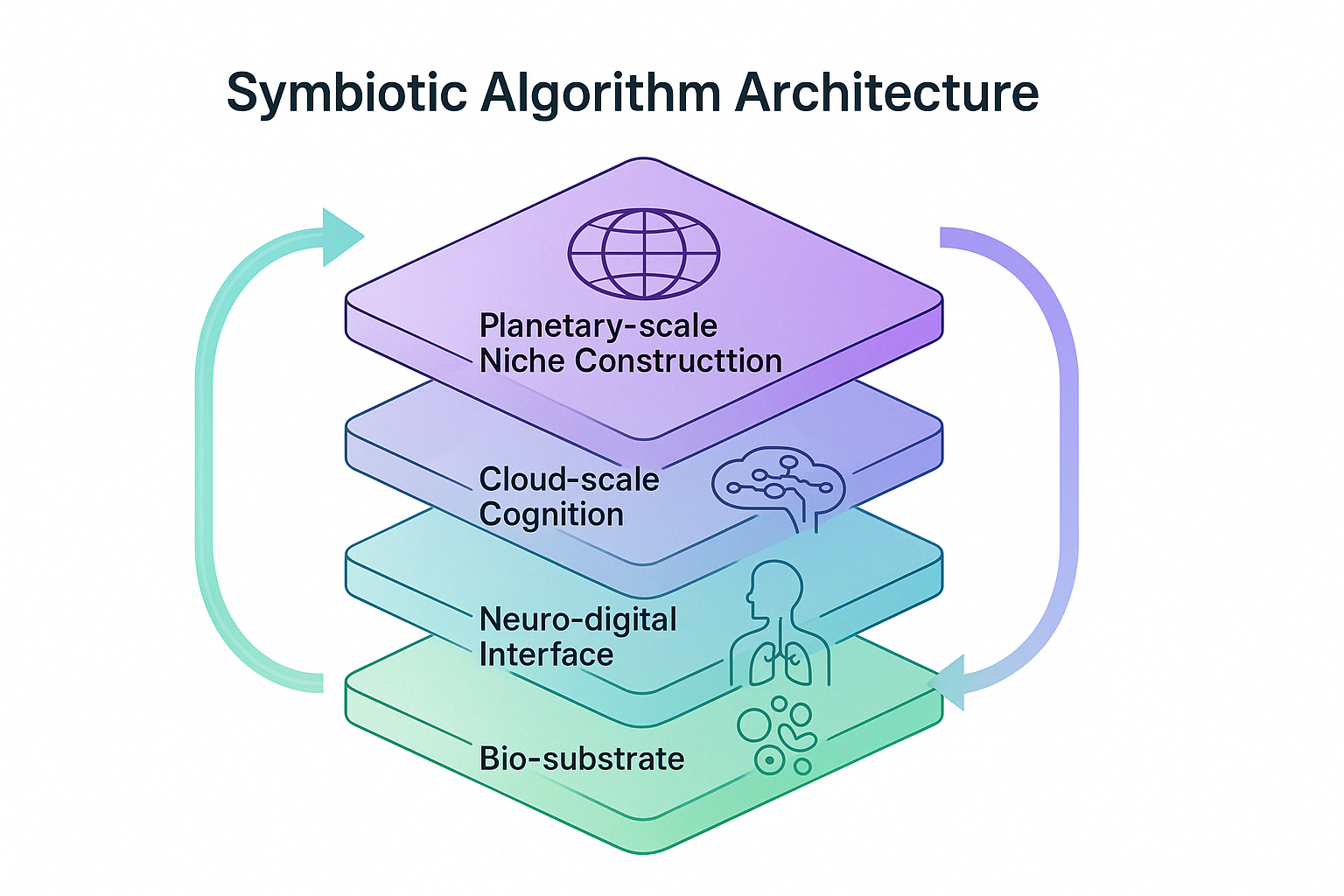
But evolution wasn't done with its "better together" strategy. Single cells eventually said, "Hey, what if we ALL stuck together after dividing?" And thus, multicellularity was born – the biological equivalent of realizing that a well-organized flash mob performs better than individual dancers scattered across a mall.
Multicellular organisms developed specialized cells – some for digestion, others for movement, still others for sensing – creating incredibly sophisticated biological machines. Think of it as nature's version of corporate restructuring, but actually effective.
Fast forward to humans emerging with their opposable thumbs and oversized brains. We started simple – pointy sticks, fire, wheels – but quickly escalated to smartphones that have more computing power than NASA used to land on the moon. And yet, this isn't some special human miracle, but rather another iteration of the same pattern we see in evolution: integrating specialized components to create systems with greater capability.
Just as cells combined to make multicellular organisms, our technologies are combining into increasingly complex, interconnected systems. Your "smart" home isn't just a collection of gadgets – it's an emerging technological organism with specialized parts working together. (Though unlike your actual organs, your smart fridge occasionally needs a firmware update and might be spying on your midnight snacking habits.)
Here's where things get truly mind-bending. The development of advanced AI might represent yet another stage in this grand universal algorithm – potentially even a major evolutionary transition on par with the jump from single cells to multicellular life.
The frightening and/or exciting possibility (depending on whether you're more "Terminator" or "Her" in your sci-fi preferences) is that humans and AI might eventually form deeply integrated symbiotic partnerships. Not just in the "Hey Siri, what's the weather?" sense, but in ways that fundamentally change what it means to be human.
Perhaps the most provocative part of the Symbiotic Algorithm challenges our human exceptionalism. We like to think we're the conscious designers of technology, the brilliant puppet masters pulling all the strings. But what if we're just another part of a larger process – nature's way of spreading complexity through yet another medium?
Research on free will suggests that even our conscious decisions might be post-hoc stories we tell ourselves after our brains have already decided what to do. So much for being the masters of our destiny!
The full cosmic implication suggests all this increasing complexity might be connected to thermodynamics – the universe's tendency to spread energy around. Complex systems like life and technology are really good at capturing energy and releasing it as heat (entropy). So maybe the universe actually "favors" the development of increasingly complex systems as super-efficient entropy producers.
In other words, the reason you exist might be that you're exceptionally good at turning a sandwich into heat. Not the ego boost you were hoping for today, is it?
If the Symbiotic Algorithm keeps unfolding, our future might involve increasingly blurry boundaries between the biological and digital. Brain-computer interfaces, bioprinting, AI-enhanced medicine – they're all early signs of this convergence.
The million-dollar question is whether consciousness and true agency could emerge in artificial systems. If your smart home eventually develops feelings, will you feel bad about turning off the lights?

In the end, the Symbiotic Algorithm suggests that biological evolution, human technology development, and future bio-digital integration aren't separate stories, but chapters in one grand cosmic cookbook – a recipe for increasing complexity through cooperation, integration, and hierarchical organization.
So the next time your devices aren't working, just remember – they're not just being annoying, they're participating in a billions-year-old universal algorithm. Though that probably won't make you feel any better when your printer refuses to connect for the fifth time today.
What do you think? Are we witnessing the next stage of evolution unfolding through our screens, or is this just a fancy way of making us feel better about our screen time? Let me know in the comments!